I was managing agents as if a chat window were an operating system. It kept the work reactive, hid the queue of unfinished decisions, and made concurrent work harder to see.
Right now, your AI agents are trapped in chat windows, idling like digital servants. They wait for your next prompt while critical decisions stack up, workflows stall, and you drown in context-switching. This isn’t the future of work. It’s a dead end.
We’ve been forcing agents into chat interfaces because that’s what we know. ChatGPT trained us to think in prompts and responses. But chat is a catastrophic interface for managing concurrent work:
- The Tyranny of the Single Thread: One conversation at a time means your entire agent workforce waits for you.
- The Amnesia Machine: Every new chat starts from zero, incinerating workflow history.
- Decision Paralysis: With ten agents needing input, how do you prioritize? You don’t. You guess.
- The Feedback Black Hole: Your decisions—the most valuable training data you have—vanish into a conversation log instead of making the system smarter.
Chat made sense when we had one agent doing one task. That era is over. I run dozens of agents simultaneously. Next year, it’ll be hundreds. Chat doesn’t scale. It collapses.
The Solution Was Invented in 1971
The answer isn’t a new technology. It’s a 50-year-old pattern that has proven its resilience for managing asynchronous, prioritized decisions at scale: the inbox.
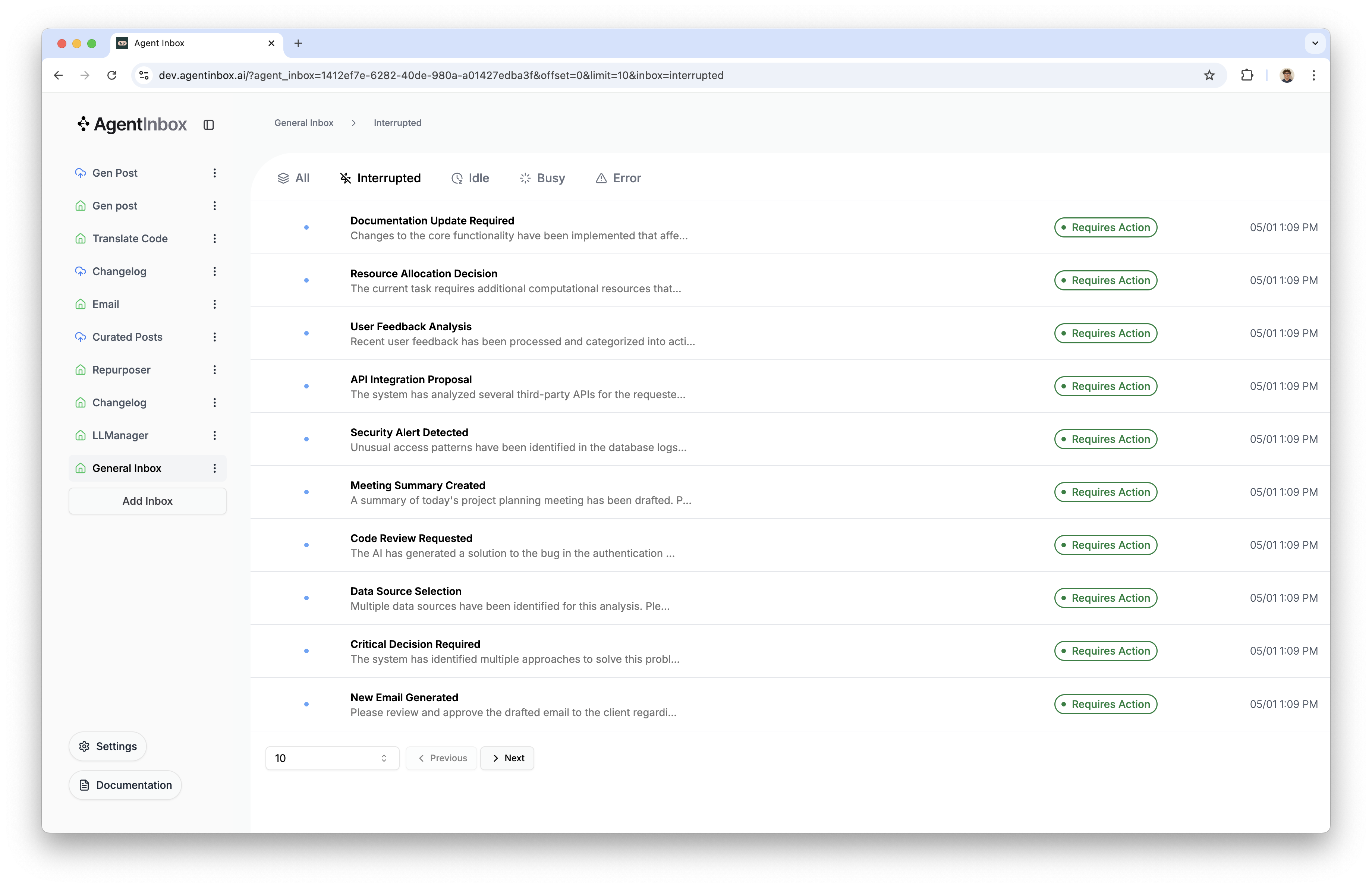 The Agentic Inbox: Not a conversation, but a decision queue.
The Agentic Inbox pattern isn’t about making AI prettier. It’s a fundamental rethinking of how humans and agents collaborate when the agents outnumber the humans 100 to 1. This isn’t theory; production deployments are showing that companies using this pattern handle 10-100x more agent workflows than they could with chat.
The insight is simple: combine deterministic workflow execution with probabilistic human judgment. This creates a system that’s both reliable and intelligent, solving the interrupt handling and feedback loops that cripple every other agentic system.
Here’s why it works.
1. Interrupts Aren’t Errors. They’re Decisions.
Instead of halting with cryptic errors or making dangerous assumptions, agents create structured interrupts. A decision packet.
This isn’t a chat message. It’s a unit of work. The agent has done its job and now requires human judgment. The human isn’t writing prompts; they are making a decision.
2. The Four Actions That Tame Complexity
Every interrupt in the Agentic Inbox resolves to one of four fundamental actions:
- Accept: Yes, proceed.
- Edit: Almost. Change these parameters.
- Respond: I need to give you more context.
- Ignore: No, skip this.
This constraint is the entire game. It transforms open-ended conversation into structured decision-making. The cognitive load plummets when every agent request has exactly four possible outcomes.
3. Kill the Single-Threaded Tyrant
The inbox, by its nature, handles concurrent workflows.
Each workflow maintains its own context. You can approve the critical database migration now and come back to the API proposal later. This is how work actually gets done.
From Inbox Zero to Agentic Inbox Zero
The parallel to Merlin Mann’s 2006 ‘Inbox Zero’ methodology is intentional. Mann’s insight was that ‘Zero’ doesn’t mean zero emails—it means zero time your brain spends in your inbox. His system (Delete, Delegate, Respond, Defer, Do) taught a generation how to process human-to-human communication efficiently.
The Agentic Inbox is the evolution of this idea for the agentic age:
- Inbox Zero (2006): Minimize cognitive load from human messages.
- Agentic Inbox Zero (2024): Minimize cognitive load from agent decisions.
The four actions (Accept, Edit, Respond, Ignore) are a streamlined version of Mann’s five because agents handle the ‘Defer’ and ‘Delegate’ logic. What remains is the uniquely human contribution: judgment, context, and strategic override.
‘Agentic Inbox Zero’ isn’t an empty queue. It’s a state of flow where agent workflows run smoothly, decisions are made instantly, and your mental energy is reserved for what matters.
The Learning Loop: From Intern to Autonomous Partner
Here is what most implementations miss: every human decision is training data.
When you ‘Edit’ an email draft, the agent learns your tone. When you ‘Ignore’ a notification, it learns your priorities. When you ‘Accept’ a tool call, it learns your trust boundaries. This creates a natural progression from intern to autonomous partner.
Phase 1: High-Touch
- Frequent interrupts for most decisions.
- Agent learns your patterns and preferences.
- Interrupt rate: 80% of decisions.
Phase 2: Selective Oversight
- Interrupts only for unusual situations.
- Agent handles routine decisions autonomously.
- Interrupt rate: 30% of decisions.
Phase 3: Exception-Only
- Agent operates fully autonomously.
- Interrupts only for true exceptions or strategic shifts.
- Interrupt rate: <5% of decisions.
I’ve watched this pattern play out in every successful agent deployment. The Agentic Inbox makes this learning process explicit and manageable.
Deterministic Workflows, Probabilistic Decisions
The power of this model is how it separates deterministic execution from probabilistic decision-making. The workflow is a reliable machine; the decision points are where intelligence and judgment are applied.
The code is predictable. The human response isn’t. This hybrid model is more powerful than pure automation or pure human control.
Why This Changes Everything
The Agentic Inbox isn’t a UI pattern. It’s a new operating model for business.
From Tools to Teammates Agents stop being tools you command and become teammates you collaborate with. They do the work, you provide the judgment.
From Configuration to Conversation Instead of writing complex rules engines, you teach the system through your decisions. Every interaction is a configuration.
From Brittle to Adaptive Traditional automation breaks on edge cases. Agentic workflows gracefully degrade to human judgment, learn from the outcome, and become more resilient.
The Implementation Path
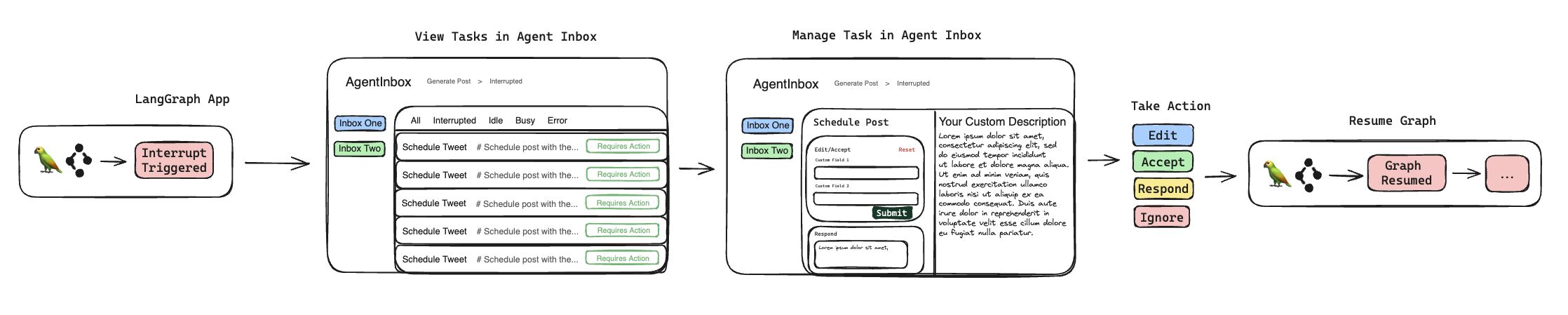 The Agentic Inbox architecture: a seamless feedback loop between agents and humans.
The pattern is proven. Here’s how to deploy it:
1. Start with High-Stakes Decisions Automate workflows where human oversight is non-negotiable: financial approvals, customer communications, production deployments.
2. Define a Strict Interrupt Schema Structure is everything. Enforce a schema for every decision packet.
3. Build the Feedback Loop Every human decision must be recorded and used to update the agent’s decision model. Your choices today automate your work tomorrow.
4. Design for Batch Processing Humans are not APIs. Don’t force them to handle interrupts one by one. Design interfaces for reviewing and acting on decisions in batches.
Tools for the Revolution
Building this from scratch is hard. A new generation of tools is emerging to make it accessible.
HumanLayer: Humans as an API Call
HumanLayer distilled this pattern to its absolute essence: what if a human was just another tool in the agent’s toolkit?
The simplicity is radical.
This changes everything. No decorators, no complex schemas, no interrupt management. Just a tool call that happens to reach a human.
The agent’s execution naturally pauses, waiting for the tool to return—exactly like calling a database. The agent doesn’t need to know it’s talking to a human.
This pattern makes human-in-the-loop trivial:
- Zero new concepts for the agent. Agents already understand tools.
- Natural pause points. Async tool calls already halt execution.
- Framework agnostic. If your agent can call tools, it can delegate to humans.
- Gradual automation built-in. Start with
human.ask()for every step. Remove it as confidence grows.
HumanLayer delivers these tool calls wherever you are—Slack, Email, SMS—and handles the routing, persistence, and timeouts. It makes humans accessible to agents through the simplest possible interface.
The Cognitive Load Revolution
Traditional automation forces you to predict every edge case upfront. The Agentic Inbox flips the model: start with human oversight, then automate based on observed patterns. This crushes the cognitive load of building and maintaining automated systems.
The Autonomous Enterprise
The Agentic Inbox is a bridge to the future. It’s how companies will transition from being human-operated to human-directed. Within five years, knowledge workers will orchestrate fleets of hundreds of agents from an inbox, and 90% of operational decisions will be automated. ‘Decision velocity’—how fast human interrupts are cleared—will become a primary KPI.
The companies that adopt this pattern won’t just be more efficient. They will be learning organizations where every human decision makes every agent smarter, compounding their advantage daily.
Chat interfaces are archives. They document work. The Agentic Inbox is a factory. It does the work.
The chat era is ending. The inbox era has begun.
Your agents are waiting for your decision.