‘The KING of billion-dollar brands. Ryan Reynolds. At 47, he is a Hollywood star who owned & sold +$14 billion worth of businesses just for fun.’
That’s how the internet celebrates the old paradigm. Let’s break down exactly how Reynolds built his empire:
The KING of billion-dollar brands.
— Mario Peshev (@no_fear_inc) May 28, 2024
Ryan Reynolds.
At 47, he is a Hollywood star who owned & sold +$14 billion worth of businesses just for fun.
I spent the weekend analyzing his work.
Here's his story, how he did it (and his most genius ads): pic.twitter.com/YMxRipGhbz
The Reynolds playbook is impressive: Aviation Gin, Mint Mobile, Maximum Effort Productions, Wrexham AFC, Alpine F1. His secret? ‘Teamwork makes the dream work,’ hands-on marketing, celebrity leverage, and authentic connections built through personal involvement in every single campaign.
But here’s what everyone’s missing: Reynolds represents the end of an era, not the beginning. His approach requires exactly what AI agents now replace.
The real revolution isn’t celebrity entrepreneurship. It’s the one-person billion-dollar brand. The one-person unicorn. And you don’t need to be Ryan Reynolds to build one.
The question isn’t whether Ryan Reynolds can build billion-dollar brands. The question is: Can AI agents make YOU a billionaire?
AI can perform tasks such as writing, coding, reasoning, and researching with great accuracy—all tasks that are key to starting your own company. That begs the question: can AI help people start their own billion-dollar business?
The tech world’s answer is unanimous: Not just yes, but it’s happening next year.
The Prediction That Changes Everything
The timeline is accelerating faster than anyone expected.
January 2024: Sam Altman captured headlines with his speculation about the world’s first one-person billion-dollar company.
A decade ago we would've thought a single-person-company had no chance of reaching a billion dollar valuation 💸
— Alexis Ohanian 🗽 (@alexisohanian) January 31, 2024
But now thanks to all this AI, it is. You heard it straight from @OpenAI CEO @sama ↓ pic.twitter.com/bxvAp5hYVT
Sam’s exact words from that interview: ‘We’re going to see 10-person companies with billion-dollar valuations pretty soon…in my little group chat with my tech CEO friends there’s this betting pool for the first year there is a one-person billion-dollar company, which would’ve been unimaginable without AI. And now [it] will happen.’
Tech CEOs aren’t debating if this will happen. They’re betting on when.
May 2025: Dario Amodei calls the bet. At Anthropic’s ‘Code with Claude’ developer conference in San Francisco, when asked during a Q&A session about when we’ll see the first billion-dollar company with only one human employee, the Anthropic CEO replied without hesitation: ‘2026.’
August 2025 (today): We’re now halfway through the year. The prediction isn’t abstract anymore—it’s imminent.
The room laughed. But nobody disagreed.
Think about the timeline:
- 18 months ago: The idea was unthinkable
- 12 months ago: Sam Altman made it thinkable
- Today: We’re halfway through 2025
- Next year: Dario says it happens
His advice? ‘Build something greater than you think is possible. And even if it doesn’t quite work yet, another model will come out in a few months which will make it work.’
The countdown has begun.
The Playbook Is Already Being Written
The shift is happening so fast that business literature is catching up in real-time. In February 2025, tech visionary Tim Cortinovis published ‘Single-Handed Unicorn: How to Solo Build a Billion-Dollar Company’—the first comprehensive guide to this new model.
His message is crystal clear: ‘You don’t need a full-time staff anymore—just the right problem to solve and the right mix of AI tools and freelancers.’
Cortinovis isn’t talking about some distant future. His book, published just six months ago, lays out the exact blueprint: ‘Under the new model, you should still identify your problem, then source the right AI to solve it.’
Think about that. While traditional business schools are still teaching org charts and hiring strategies, new books are teaching how to build billion-dollar companies without hiring anyone at all.
The Death of Traditional Business Models
After running agency after agency, I had a revelation that changed everything: agencies are nothing more than servicing companies. Glorified middlemen coordinating human labor to execute on someone else’s vision. The entire traditional business model—hiring employees, managing contractors, scaling headcount—is built on a fundamental constraint that no longer exists.
That constraint? The need for human labor to scale operations.
Traditional businesses scale through people:
- Hire employees to handle operations
- Contract specialists for expertise
- Build teams to manage growth
- Layer management to coordinate complexity
But what happens when AI agents can do all of this? When agentic workflows replace entire departments? When one person can orchestrate a thousand simultaneous operations?
The agency dies. The traditional business model dies. And something unprecedented emerges.
Enter the One-Person Billion-Dollar Brand
The one-person billion-dollar brand isn’t just a company with fewer employees. It’s a fundamentally different organism. As I explored in Agentic Companies, this is an organization that is AI, not one that merely uses AI.
The Reynolds Playbook vs. The Agentic Playbook
Let’s dissect exactly how Reynolds built his $14B empire versus how you’ll build yours:
The Reynolds Playbook (Traditional):
- Build celebrity status first: 20+ years in Hollywood to gain leverage
- ‘Teamwork makes the dream work’: Hire agencies, teams, partners for every venture
- Hands-on everything: Personal involvement in every ad, every campaign
- Trend-jacking with teams: Creative teams monitoring culture, crafting viral responses
- Authentic connection: Personally taste the gin, use the product, be in the ads
- Maximum Effort Productions: Build your own agency to control the narrative
- Multiple investors & partners: Share equity to access capital and expertise
The Agentic Playbook (One-Person):
- No celebrity needed: AI agents are your distribution, not your fame
- AI agents are the team: Deploy thousands of specialized agents, not employees
- Infinite Market: Serve trillions of AI agents, not just 8 billion humans
- Orchestrate, don’t execute: Direct workflows while AI handles execution
- 24/7 trend monitoring: AI agents track and respond to culture in real-time
- Scale authentic value: AI maintains brand voice across millions of interactions
- No agency needed: AI agents handle creative, production, distribution
- Solo ownership: Keep 100% equity, scale through compute not capital
The Ultimate Irony
Here’s what makes Reynolds’ success both impressive and obsolete: Maximum Effort Productions, his crown jewel, is a traditional agency. The very company that enabled his billions is exactly what AI agents are eliminating.
Think about what Maximum Effort actually does:
- Creative teams brainstorming viral ideas → AI agents generating infinite variations
- Writers crafting scripts → AI agents producing personalized copy at scale
- Directors and editors producing ads → AI agents creating content 24/7
- Account managers coordinating campaigns → AI workflows running autonomously
- Analytics teams measuring performance → AI agents optimizing in real-time
Reynolds built an agency because he needed one. You won’t build an agency because you won’t need one.
The real kicker? While Reynolds was trend-jacking with Peloton’s viral moment, requiring his entire team to scramble and produce a response ad in days, an AI-powered founder could have responded in minutes. By the time Maximum Effort’s meeting ended, the agentic version would have already launched, tested, and optimized a thousand variations.
This isn’t theoretical. The building blocks are here now.
The New Equation for Billion-Dollar Scale
The math that makes one-person unicorns possible is beautifully simple:
Internet Scale × AI Agents × Value Creation = Billion-Dollar Valuation
Let me break this down:
Internet Scale: Transcending the Human Market
The internet gave traditional businesses a total addressable market of every person on earth—nearly 8 billion potential customers. This was the ceiling. Your growth was ultimately capped by the human population.
AI breaks this ceiling. The next generation of companies won’t just serve humans. They will primarily serve other AI agents, a customer base that is not limited to 8 billion but can scale infinitely. The distribution bottleneck is gone, and now, the market cap is gone, too.
AI Agents: Infinite Workforce
While Ryan Reynolds needs to hire teams to handle customer service, product development, and operations, you deploy agents. Need customer support for a million users? Deploy agents. Need to personalize marketing for every demographic? Deploy agents. Need to iterate on product features based on user feedback? Deploy agents.
The workforce constraint vanishes. You’re not managing people; you’re orchestrating workflows.
Evan Armstrong at Every.to broke down the impossible math of solo billion-dollar companies:
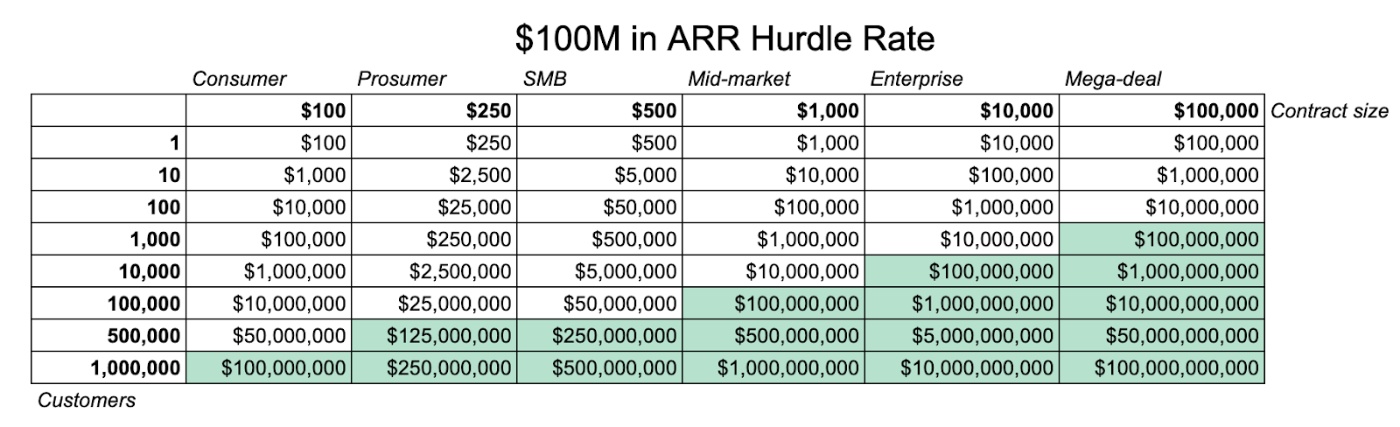 Source: Every.to - The One-person Billion-dollar Company
The numbers are staggering. To build a $100M ARR business with consumer pricing ($100/year), you need 1 million paying customers. The New York Times has 10 million subscribers—with 5,800 employees. A solo founder would need to capture 10% of the Times’ market with 0.017% of its staffing.
Without AI agents, this is impossible. With them, it’s Tuesday.
Value Creation: The Only Metric That Matters
A billion-dollar brand is nothing more than a reflection of the value it creates. And here’s the key insight: AI agents don’t just serve human customers anymore. They serve other AI agents. Your brand might provide value to millions of human users while simultaneously serving billions of AI agent interactions.
The total addressable market isn’t 8 billion humans. It’s 8 billion humans plus trillions of AI agents.
The Plot Twist: Your Customers Won’t Be Human
This is the most important shift in thinking. While traditional companies chase a finite market of 8 billion people, the agentic company targets an infinite one. The one-person billion-dollar brand won’t primarily serve humans. It will serve AI agents.
In April 2025—after Sam’s predictions but before Dario’s conference—Fly.io dropped a bombshell: ‘Our Best Customers Are Now Robots’.
Their confession is stunning in its clarity:
We’re Fly.io, a developer-focused public cloud. We spent years coming up with a developer experience we were proud of. But now the robots are taking over, and they don’t care… If you look at the numbers, DX might not matter that much. That’s because the users driving the most growth on the platform aren’t people at all. They’re… robots.
Think about what this means. A major cloud platform—built by humans, for humans—is now experiencing its fastest growth from AI agents. Not in some hypothetical future. Right now.
The math is undeniable:
- Human population: 8.2 billion (hard cap)
- AI agent population: Infinite (and exponentially growing)
Every human-focused business faces a fundamental ceiling: there are only so many humans. But AI agents? They can spawn infinitely, work 24/7, and each one is a potential customer for your services.
This is why I’ve been writing about Agentic Experience (AX)—the shift from optimizing for human users to optimizing for AI agents. Fly.io learned this the hard way: their carefully crafted developer experience doesn’t matter to robots. What matters is:
- Lightning-fast VM creation and teardown
- Stateful storage for iterative ‘vibe coding’ sessions
- Predictable APIs and deterministic behavior
- Machine-readable everything
The one-person unicorn won’t build consumer apps with beautiful UIs. They’ll build infrastructure, APIs, and services that AI agents consume at scale. Your billion-dollar valuation won’t come from 10 million human subscribers paying $100/year. It will come from 100 million AI agents paying $10/year—or a billion agents paying $1.
As Fly.io discovered: ‘Fuckin’ robots’ are the future. And they’re already here.
From Agency Owner to Agentic Orchestrator
My journey from running traditional agencies to envisioning agentic companies taught me this: every agency is about to be disrupted by a single person with the right agentic workflows.
Consider what an agency actually does:
- Creative Services: AI agents generate, iterate, and optimize creative assets
- Strategic Planning: AI agents analyze markets, identify opportunities, craft strategies
- Project Management: AI agents coordinate tasks, track progress, ensure delivery
- Client Communication: AI agents handle updates, reports, and routine interactions
I used to need 20 people to run an agency serving 10 clients. With agentic workflows, one person could serve 1,000 clients. Or 10,000. The limitation isn’t labor anymore—it’s imagination.
The Tools of the One-Person Unicorn
Thinking of launching a startup? AI could be your staff.
Forget hiring. Forget equity splits. Forget office leases and team-building retreats. The tools to build your one-person unicorn are already here.
Building a one-person billion-dollar brand requires a specific stack, which I’ve been developing and documenting:
- Open-source AI models running on private infrastructure (no API dependencies)
- Fundamental tools like code interpreters and browsers (not curated, limited toolsets)
- Agentic workflows that chain operations autonomously
- Simple interfaces for orchestrating complexity
This isn’t about no-code tools or simplified platforms. It’s about wielding the full power of AI agents with the sophistication of a conductor leading an orchestra.
Reynolds’ 7 Lessons, Transformed for the Agentic Age
The Twitter thread analyzing Reynolds extracted 7 key lessons. Here’s how each transforms in the age of AI agents:
-
‘Fail forward’ → Iterate at AI speed: While Reynolds learns from one failed campaign, AI agents can run thousands of experiments simultaneously, learning and adapting in real-time.
-
‘Take risks & bet on yourself’ → Bet on agentic leverage: The biggest risk now is NOT using AI agents. Betting on yourself means betting on your ability to orchestrate, not execute.
-
‘Teamwork makes the dream work’ → Agent swarms make miracles: Replace human teams with agent swarms. One person directing 1,000 AI agents beats 1,000 humans every time.
-
‘Find your niche and lean into strength’ → Let AI handle your weaknesses: You don’t need to be good at everything. Focus on vision and strategy; AI agents handle everything else.
-
‘Stay true to your vision, beliefs, and values’ → Embed values in agent workflows: Your values scale through AI. Program them once, deploy them infinitely.
-
‘Building an authentic following is the greatest leverage’ → Value creation is the only leverage: You don’t need followers when AI agents can deliver personalized value to millions simultaneously.
-
‘Use your success to give back’ → Democratize success itself: The one-person unicorn model doesn’t just let you give back—it gives everyone the tools to build their own.
Real-World Examples Emerging Now
While the full one-person unicorn hasn’t emerged yet, we’re seeing the precursors:
- Solo creators earning millions with AI-assisted content production
- Individual developers building and scaling SaaS products serving thousands
- Single operators running e-commerce empires through automation
- Lone consultants outperforming entire firms using AI agents
Each represents a step toward the inevitable: the first true one-person billion-dollar brand.
Why This Changes Everything
The one-person billion-dollar brand isn’t just about making money. It’s about fundamentally restructuring how value is created and captured in the economy.
When one person can create what previously required thousands, several shifts occur:
- Radical Efficiency: No office overhead, no HR departments, no middle management
- Perfect Alignment: No principal-agent problems, no internal politics, no communication overhead
- Infinite Scalability: Growth isn’t constrained by hiring or management capacity
- Pure Meritocracy: Success depends solely on value creation, not team building or people management
This isn’t the gig economy or solopreneurship as we know it. It’s a new category entirely.
The Only Question That Matters
The fundamental pivot for the next generation of builders is not from one product to another. It is from one customer to another—from serving the finite world of 8 billion humans to serving the infinite world of AI agents.
Serving people requires apps, content, and experiences. Serving agents requires infrastructure: the APIs, data pipelines, and computational resources they consume at scale. The one-person unicorns won’t be building the next shiny app for humans. They will be building the silent, invisible plumbing that empowers a trillion AI transactions.
This brings us to the only question that matters.
Are you building the infrastructure that empowers AI agents?
Further Reading: